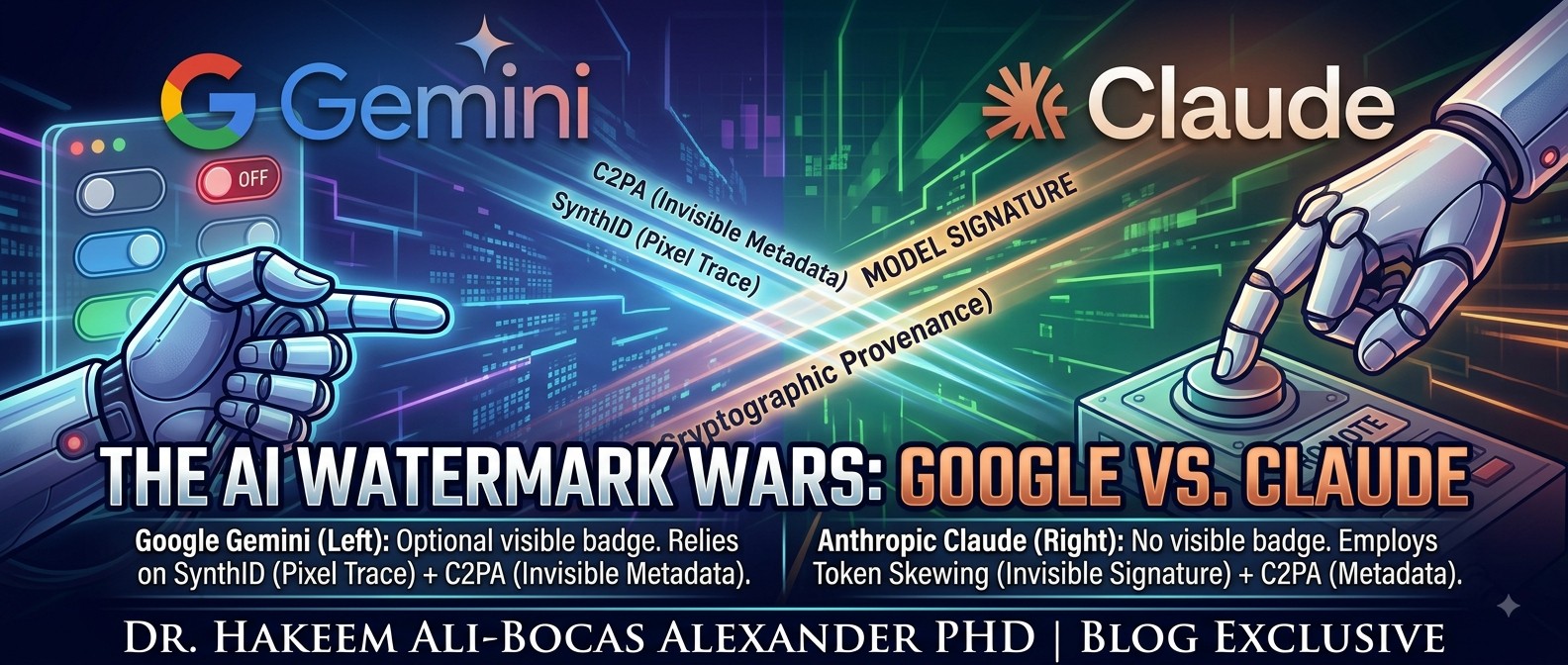
Recently, two of the biggest players in the AI industry—Google and Anthropic (Claude)—took simultaneously opposing and aligned approaches to a single problem: AI content watermarking. In a recent podcast episode, I explored this divergence, and how it reveals a deeper conflict between user experience and regulatory compliance.
Below, we break down the key strategies from the “AI Watermark Wars.”
The Core Divergence: Visibility vs. Mandatory Tracking
Why did Google remove the visible watermark from Gemini?
As I discussed on the podcast, many creators, myself included, dislike prominent, burned-in watermarks (like Gemini’s four-pointed star). We’ve historically relied on manual post-processing (cropping, black boxes) to clean up professional assets.
Google has listened to this feedback. The recent change allows a simple setting toggle to turn off visible badges on:
Gemini (Images)
Google Omni (Video)
Google Lyria (Music)
This decision focuses heavily on providing a polished user experience (UX) for creators.
If the watermark is off, how is Google’s media still identified as AI?
Google has not abandoned tracking; they’ve simply made it invisible. The tracking mechanism is moved entirely into the mathematical code of the file using two layers:
SynthID: A deep, frequency-domain signature embedded directly into the pixels of an image or video frames. It is undetectable by the human eye but remains resilient to basic editing.
C2PA Metadata: This is a set of standardized, cryptographic data tags attached inside the image file that acts like a digital “nutrition label” for provenance.
Claude (Anthropic): Mandatory, Global Invisible Signatures
What is Claude’s new mandatory watermarking system?
While Google focuses on UX by making visible tracking optional, Anthropic’s Claude is taking a more aggressive stance, aiming for global regulatory compliance.
Claude has implemented mandatory, model-level watermarking across all its platforms and outputs (web, API, and developer tools):
Mandatory Invisible Tracking for Text: Utilizing techniques based on the DeepMind open-source SynthID-Text framework, Claude uses statistical token manipulation (token skewing) to subtly alter word choices. This leaves a hidden, mathematically verifiable signature in the output that does not affect the readability of the text.
C2PA Metadata for All Files: All files (JPG, PNG, and even vector SVGs) exported from Claude now include mandatory, signed C2PA metadata.
Why do Google and Claude’s strategies differ so much?
This divergence perfectly illustrates the trade-off currently facing the AI industry.
Google’s priority is currently Creator Experience & Adoption. By removing the friction of a burned-in logo, they make their tool more useful and professional for creatives.
Claude’s priority appears to be Regulatory Compliance & Transparency. They are aligning with new mandates, such as the EU AI Act, which will require all foundation models to be transparent about AI generation and provenance.
The Verdict
This divergence is just the first salvo in the “AI Watermark Wars.” As regulations increase, it remains to be seen if Google’s optional, “polish-first” approach will remain compliant, or if the mandatory standard adopted by Claude will become the industry norm.
I will continue to monitor these developments and provide updates as they evolve.
🎧 Listen to the Full Analysis
I provided an extensive breakdown of this topic on my latest podcast.
Listen to the full episode below and share your perspective: Is the future of AI tracking visible, invisible, optional, or mandatory?
Submitted by Dr. Hakeem Ali-Bocas Alexander, PhD